
The Mayoral Prank That Elected Her
They put her name on a mayoral slate as a prank. She chose to serve. Voters chose her.
Follow the surprise nomination into the election, the records and the limits of women’s voting rights at the time.
Article + historical sources
THE FULL STORY.
On April 4, 1887, voters in Argonia, Kansas, elected Susanna Madora Salter mayor. Several men had nominated her as a joke. She received roughly two-thirds of the vote. The Kansas Historical Society recognizes her as the first woman mayor in the United States. Kansas Historical Society
The surprise makes a memorable headline. Understanding the election also requires a second question: what did Salter do when she learned that her name was on the ballot?
Salter chose to serve
Salter was an officer in Argonia’s Woman’s Christian Temperance Union, a group involved in local politics and enforcement of prohibition. In historian Monroe Billington’s 1954 account, the women selected a slate of men for municipal office. A faction hostile to their political activity then printed a similar slate, substituting Salter’s name for mayor. The men expected her defeat to embarrass the women. Billington’s study
Salter had not agreed to that nomination. On election day, supporters approached her and asked whether she would accept the office if elected. She agreed. That decision belongs at the center of the story: the nomination was a surprise, and serving was a choice. Voters then made their own decision. Billington’s study
The eventual result was decisive. Roughly two-thirds of the vote means approximately two votes in every three went to Salter. It does not give us an exact ballot count, and it does not mean that her winning margin was two-thirds. The short KHS account states a vote share; this article preserves that level of precision. Kansapedia account
THE TIMELINE.
The election fell within a longer change in Kansas political life:
| Date | What happened |
|---|---|
| 1861 | Kansas women gained school district voting rights. |
| 1887 | Kansas expanded women’s voting rights to municipal elections. |
| April 4, 1887 | Argonia elected Salter mayor. |
| April 6, 1887 | An official notice informed her of that election. |
| November 5, 1912 | Kansas voters approved the state’s equal-suffrage amendment. |
The franchise dates come from the KHS suffrage history; the election and notice dates are recorded in the contemporary municipal notice reproduced by KHS.

Municipal voting concerned city government. The 1887 change did not give women equal voting rights in every Kansas election or throughout the United States. Nor was it the first time Kansas women had any voting rights: school elections preceded it. Those distinctions help explain how Salter could become mayor while the wider campaign for equal suffrage continued. The National Park Service’s Salter House history also distinguishes town elections from national elections.
READ THE RECEIPTS.
The April 6, 1887 notice: This is the closest evidence here to the election itself. The reproduced handwritten document addresses Dora Salter and reports that the election held on April 4 had elected her mayor. April 6 is the notice date, not a competing election date. The notice supplies no vote tally, account of the prank, or record of her consent. Notice image
The 1954 historical study: Billington reconstructed events from interviews with Salter and access to her papers. Its consent passage cites a 1933 newspaper. It also recounts a newspaper correspondent observing her keeping council discussion on business. These are useful historical accounts, but reading Billington is different from inspecting every original clipping he used. His notes acknowledge that some clippings were unidentified or undated. Study and endnotes
The modern KHS page: Created in 2010 and modified in 2016, the short Kansapedia entry summarizes the prank, election date, vote share, and U.S. distinction. It offers a concise official synthesis rather than a new contemporary election record. Kansapedia entry and metadata
- The 1887 election notice ↗
Primary document reproduced by the Kansas Historical Society. Read the election date separately from the date on the notice.
- Monroe Billington’s 1954 study ↗
Historical reconstruction and endnotes. Explains the nomination, Salter’s agreement to serve and contemporary coverage.
- KHS biography of Susanna Madora Salter ↗
Official historical summary, including the reported vote share and first-woman-mayor distinction.
- KHS history of woman’s suffrage ↗
School elections, city elections and the later state suffrage amendment.
- National Park Service — Salter House ↗
Place-based history and the distinction between town and national elections.
WHAT THE RECORD SHOWS.
The Kansas Historical Society recognizes Salter as the first woman mayor in the United States. This article follows that attribution and makes no world-first claim.
The April 6 notice documents an April 4 election. It does not establish the prank, consent or vote total. Those details come from the later accounts linked above.
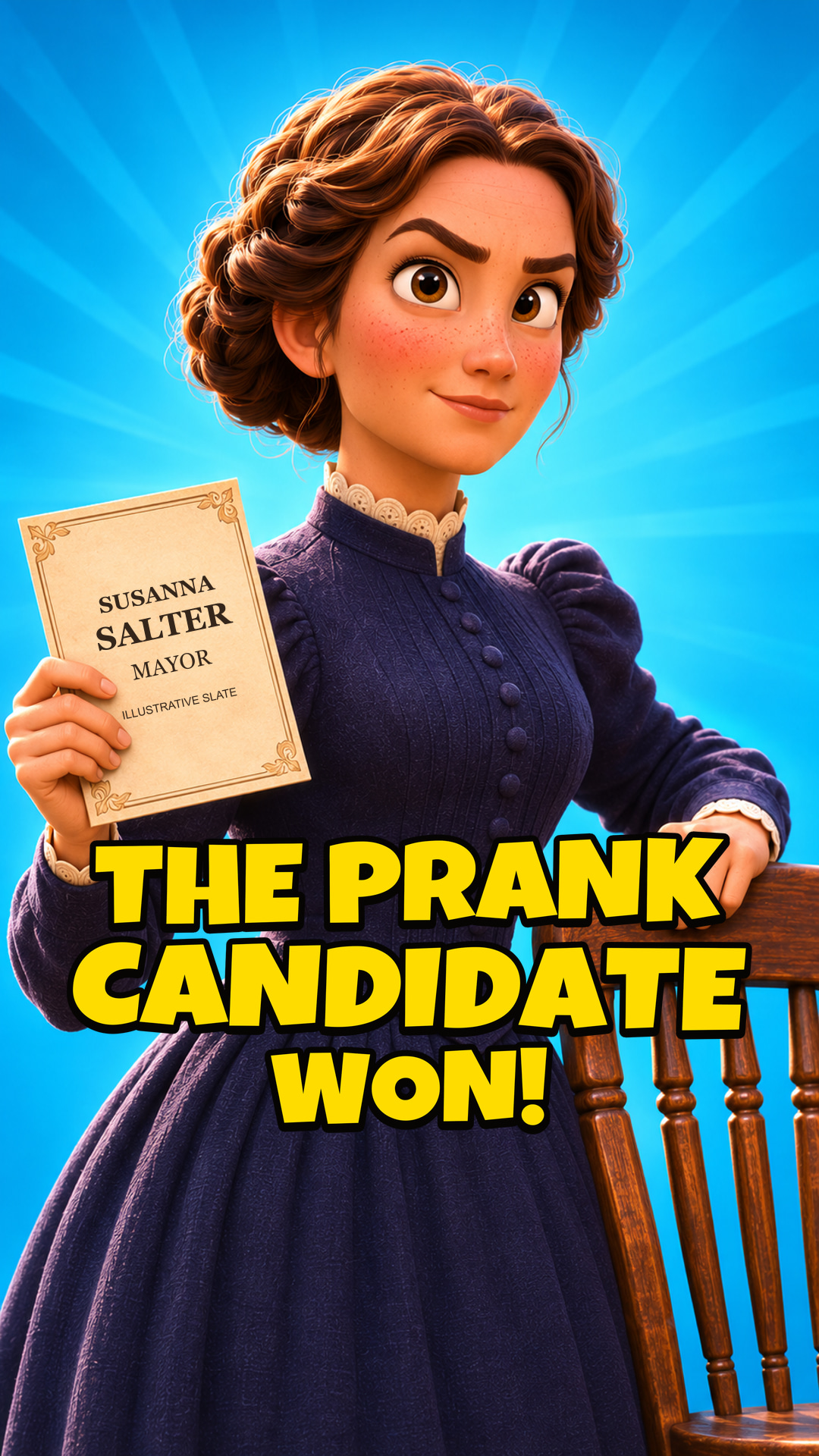
The cover is a stylized historical reconstruction, not a photograph or a surviving candidate slate. Its illustrated slate is not an authenticated original ballot or candidate list.
TAKE THE CHALLENGE.
Salter served a year and did not seek reelection. The joke explains the unexpected nomination; assessing her as an official requires attention to her conduct in office. Billington’s study
Imagine writing two headlines: one about the men’s prank, another about Salter accepting responsibility and voters choosing her. Which gives readers a fuller account? Then identify one piece of evidence you would want before calling her a capable mayor: council records, enforcement decisions, meeting reports, or residents’ testimony. A surprising route onto a ballot can attract attention. Evaluating public service takes another kind of curiosity.
- LEVEL 1 · READ
Find the two dates
Open the 1887 notice. Identify when the election happened and when the notice was written. What does the document actually confirm?
- LEVEL 2 · COMPARE
Write the other headline
Write one headline about the prank and one about Salter’s decision to serve. Which gives her agency? Check the 1954 study and its endnotes before choosing.
- LEVEL 3 · LOOK LOCALLY
Look past the campaign story
Choose a local public official and find one council agenda, meeting record or recorded decision. What evidence would help you judge their work in office? Keep the record’s date and link with your notes.
The headline is the beginning.
Who gets taken seriously in public life, and how do we judge the work they actually do? Start with the records above. If you want to keep going, explore America House’s civic projects and ways to contribute.