
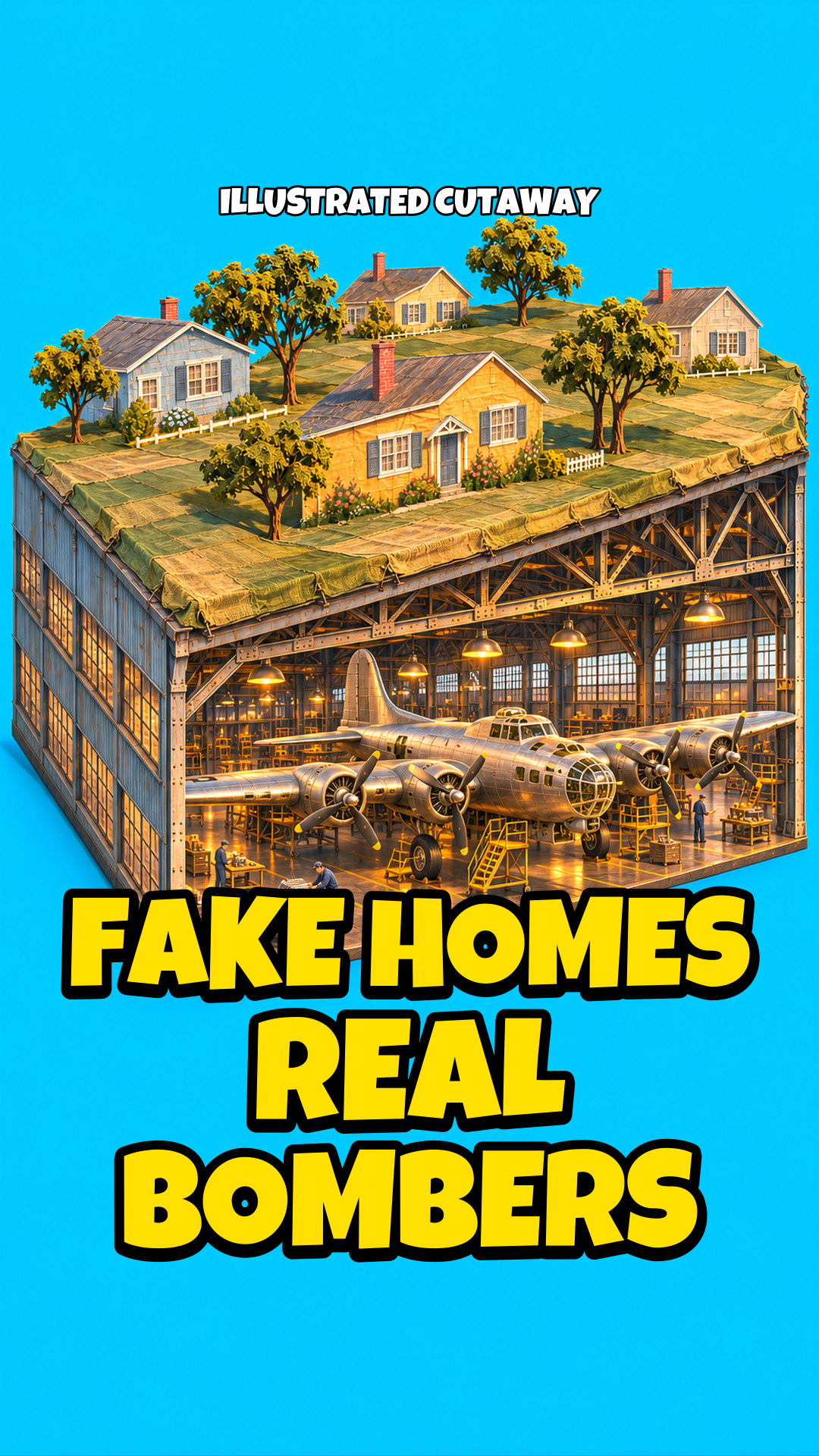
The Fake Neighborhood Above Seattle's Bomber Factory
A wartime roof became a make-believe landscape. Follow the evidence from stagecraft to factory floor, and learn where the story's spectacular appearance stops proving anything.
THE FULL STORY.
The factory with a second skyline
During World War II in Seattle, Washington, USA, Boeing Plant 2 produced B-17 bombers beneath a roof dressed as a hillside neighborhood. The apparent homes were constructed scenery, not a residential district. The first surprise is visual; the second is conceptual. A place can convincingly resemble something without serving any of its usual purposes.
A factory roof normally advertises its function through long edges, mechanical forms and repeated lines. Smaller shapes can interrupt those clues. This helps explain the design concept, but it is not evidence about what a particular pilot noticed. The picture viewers remember and the result a historian can establish are different questions.
A defense built to be seen differently
The U.S. Army Corps of Engineers intended to obscure the site from foreign aerial observation. Looking unlike an aircraft-production facility had defensive appeal during World War II. Still, making a target harder to recognize was an objective, not a result proved by completing scenery. Builders could shape a roof; they could not dictate every observer's interpretation.
Boeing and an official Army history describe about 26 acres of rooftop village. Making separate objects read as one landscape would require attention to scale, spacing and contrasting textures. Those ideas help a reader understand camouflage without pretending to reconstruct a secret flight or an enemy pilot's view. The records establish a project, not a successful encounter.
Canvas cottages and manufactured trees
A Boeing archival caption describes painted-canvas cottages, artificial trees made with wood and wire mesh with chicken feathers, and lawns of green burlap. Ordinary housing is designed for daily life; this installation was designed to resemble housing from another perspective. Its usefulness as an image depended on visible shapes, not on families moving in or rooms being furnished.
The same catalogue reports sizable material inputs. Lumber measured in board feet describes volume; chicken wire measured in square feet describes area. Those numbers should not be casually exchanged or converted into lengths. The caption also says the disguise extended onto Boeing Field. So an overall materials figure cannot automatically be assigned just to cottages on the roof.
Evidence: B02
The production line downstairs
Below the scenery, workers handled the practical demands of an industrial plant. Large aircraft structures had to be positioned and aligned; rooftop scenery did not turn production into theater. An illustrated cutaway places two spatial layers in one image, openly showing what no ordinary camera could photograph through solid roofing. It explains the arrangement, not a documentary viewpoint.
Boeing reports nearly 1.7 million square feet for the expanded Plant 2 facility by war's end. That number and the rooftop acreage do not establish matching boundaries. Treating them as one footprint would yield a dramatic calculation with no sound basis. Even perfect arithmetic misleads when measurements describe different spaces. The useful question is what each number represents.
Pictures with names and dates
The Library of Congress engineering index identifies a northeast-facade camouflage photograph, WA-189-71, dated March 1945. The date belongs to the photograph's catalogue entry, not to the first construction of the installation. An index helps readers locate and identify a record; it is not a substitute for independently examining every visible feature. Nor can one picture establish a military outcome.
The Army's published history reproduces photographs credited to Boeing. Their appearance in another publication does not turn them into independent photographic evidence. A University of Washington architectural history separately links Hollywood production designer John Stewart Detlie with Seattle camouflage work. His involvement helps explain the scenic skills behind the project, but it does not make him the sole creator or builder.
When the neighborhood disappeared
Army history places extensive regional camouflage efforts around 1942, but that context is not an exact completion date for Plant 2. The March 1945 index entry marks a photograph, not a construction milestone. Boeing reports the disguise was dismantled in 1946, without establishing the day. Together the records offer a useful sequence, but not a complete daily log.
An Army account discusses an unconfirmed reconnaissance-related report. That does not prove an enemy plane did or did not observe Seattle, or that the rooftop prevented an attack. The meaningful distinction is between what people intended, what they constructed, and what observers actually experienced. Two of those can be discussed from these records; the last needs different evidence.
THE TIMELINE.
| When | What the record describes |
|---|---|
| World War II | B-17 production continues beneath rooftop camouflage. Installation date not established. |
| 1942 | Army describes regional camouflage efforts; university history places Detlie in Seattle. Not a Plant 2 completion date. |
| March 1945 | HAER index dates a northeast-facade camouflage photograph. Photograph date only. Evidence: L01 |
| 1946 | Boeing reports Army-engineer dismantling. Exact day unspecified. Evidence: B01 |
READ THE RECEIPTS.
- Boeing: History of the Duwamish Waterway ↗
Participant-company retrospective. Factory production, defensive rooftop design and removal.
No demonstrated enemy deception.
- Boeing Images: Camouflaged Plant II, BI210990 ↗
Historical photograph and modern catalogue. Scenic materials, reported quantities and wider installation.
Not an audited inventory; image rights-managed.
- U.S. Army: Guarding the United States and Its Outposts ↗
Official retrospective, accessible mirror. Regional context and qualified reconnaissance discussion.
Boeing-credited images; no confirmed deception.
- Library of Congress: HAER WA-189 Photograph Index ↗
Government photographic catalogue. Identifies March 1945 photograph WA-189-71.
Index, not independent image inspection.
- University of Washington: Terry-Lander Historic Resources Addendum ↗
Retrospective architectural biography. Detlie's documented connection to camouflage work.
Not proof of sole authorship.
FACT VS. ASSUMPTION.
Claim: Real families lived in rooftop houses.
Scenery, not residential homes; occasional access cannot be ruled out.
Claim: An enemy pilot definitely fell for it.
Records show purpose and construction, not successful deception.
Claim: All materials belonged to rooftop cottages.
The documented installation extended onto Boeing Field.
Evidence: B02
Claim: March 1945 was the completion date.
It dates an indexed photograph, not construction.
Evidence: L01
No examined source demonstrates a deceived aircraft, prevented attack, exact construction day, measured performance or audited project cost.
THE TRANSCRIPT.
Brian: World War Two: Seattle's bomber factory wore a fake rooftop neighborhood.
Brian: The U.S. Army Corps of Engineers aimed to hide Boeing Plant Two from above.
Brian: Canvas cottages, fake trees. Scenery, not residential homes.
Brian: Workers below assembled B seventeen bombers.
Brian: The fake rooftop covered about twenty-six acres.
Brian: It came down in nineteen forty-six. These sources don't prove it fooled enemy aircraft.
Eagle: America… explain yourself.
TAKE THE CHALLENGE.
The useful test is to separate three questions: What was intended, what was built, and what happened afterward? An image can illustrate an invention, while a dated catalogue can help locate evidence. Neither automatically measures effectiveness.
- LEVEL 1
Find the disguise
From Boeing's account, identify one scenic feature and the industrial activity beneath it.
Evidence: B01
- LEVEL 2
Trace a photograph
Compare the Army history and HAER index: what comes from an image, a caption, or later interpretation?
- LEVEL 3
Follow a public project
Identify a local agency's objective, action and recorded outcome; privately draft one narrow question if evidence is missing.
FOLLOW THE EVIDENCE.
Start with one source and one specific question. To explore civic projects and ways to contribute, see America House.